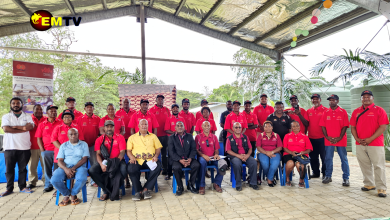



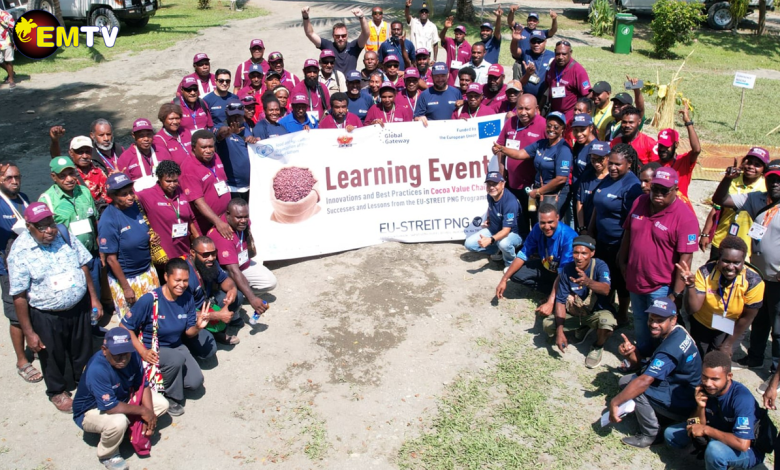
The EU-funded Support to Rural Entrepreneurship, Investment, and Trade in Papua New Guinea (EU-STREIT PNG) Programme concluded a two-day National Learning and Innovation Event in Wewak, East Sepik Province.
The event bought together over 42 participants including government officials, technical experts, private sector representatives, and development partners from across the country.
The event provided a platform to share knowledge, showcase the Programme’s Value Chain Development model, and discuss strategies for replicating its model nationwide.
Participants representing cocoa board and department of agriculture from all provinces had the opportunity to experience firsthand transformational approaches in agriculture and innovations through interactive demonstrations and targeted field visits at Hawaiian Nursery for cocoa and Mandi Village for vanilla value chains.
These visits illustrated improved farming techniques, advanced processing and post-harvest innovations, digital tools facilitating access to premium niche markets, as well as the critical roles played by government agencies, exporters, processors and financial service providers.
Attendees also observed and were briefed about the enabling support measures including upgraded transport infrastructure, ICT solutions, digital tools, and financial services that have collectively driven inclusive agricultural value chain-driven development in the Sepik region.
The EU-STREIT PNG Programme Coordinator, Ali Said Yesuf, underscored the significance of the event, stating, “We organised this event to share what we have learned during the last five years of Programme implementation, particularly in transforming the cocoa and vanilla value chains. As the programme nears its conclusion, it is critical to widely disseminate our successful approaches, innovations, and the strong collaborations forged with the private sector, national and provincial governments, farmers, and MSMEs. This gathering is about exchanging experiences and sharing best practices and lessons so that our achievements can be sustainably replicated and contextualised by other provinces according to their unique needs.”
Representing the Papua New Guinea’s Department of National Planning and Monitoring, Assistant Secretary and the Head of National Authorizing Officer Support Unit, Mr Floyd Lala, emphasized the government’s commitment to supporting replication efforts: “The EU-STREIT PNG Programme resulted from rigorous consultation to align with our national development priorities, especially within the Medium-Term Development Plan. We have seen significant positive changes, particularly in rural communities. Our focus now is on supporting other provinces to adopt this successful model. Replication is about adapting key principles and contextualising them to local circumstances, recognising the uniqueness of each province. The interest expressed by provinces during this event demonstrates substantial momentum to move forward.”
Deputy Provincial Administrator for Western Highlands, Emil Tigil, who attended the event, also shared his reflections: “The two days have been very fruitful. On behalf of the participants and the Highlands team, I’d like to acknowledge the EU-STREIT PNG Programme for initiating this Learning Event. Exposure and leadership are key to progress and this event offered both. Visiting the cocoa site gave us valuable insight into how we can elevate production and quality for export. The vanilla site was equally meaningful. Life is made up of moments, and this event and exposure has been an important one for all of us.”
An important outcome of the event was the consensus by the participating government agencies to collaboratively draft a concept note. This document will outline concrete next steps, necessary resources, partnership strategies, and relevant policies required for successfully replicating the EU-STREIT PNG model in other regions. It will form a solid foundation for resource mobilization, strategic planning, and constructive policy dialogue between provincial administrations, the National Government, and development partners.
Participants also stressed the critical need for provincial and national institutions to integrate these insights into their respective planning and budgetary processes. Ensuring such integration will be vital for achieving sustainable and enduring impacts beyond the Programe’s conclusion in 2026.