


By Ancilla Ilave
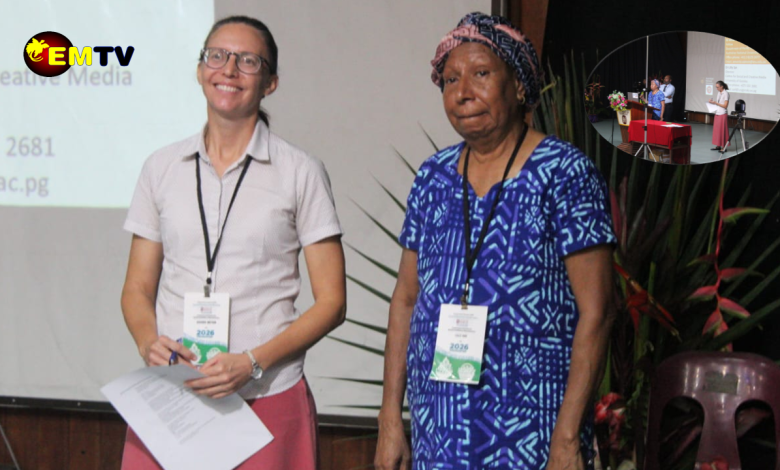
Center for Social and Creative Media at the University of Goroka, Director, Dr Lilly Sar (right) and fellow presenter Dr. Amanda H. A. Watson from the Department of Pacific Affairs at the Australian National University during presentation at the Food and Nutrition Conference at Papua New Guinea University of Technology in Lae. Picture supplied.
There are many challenges in terms of food and nutrition awareness in Papua New Guinea, and the most important aspect is communication and how to get important information to the rural population as they are subsistence farmers.
Center for Social and Creative Media at the University of Goroka, Director, Dr. Lilly Sar did a presentation on participatory action research that focuses on communication during the Food and Nutrition Conference held at the Papua New Guinea University of Technology in Lae.
Dr. Sar stated during the presentation that participatory action research allows scientists, extension staff, farmers, and stakeholders interested in a given situation to work, learn, and do things together.
Some examples of participatory action research include communication through visuals, interaction, and utilizing facilitators on the ground, which is also cost effective.
She said, especially for farmers, that there’s that learning that takes place where multiple stakeholders are working together.
“Education, scientists and researchers. Most times, its researchers are working on their own, and they pass down the information to the farmers,” Dr Sar said.
Research breaks that line and closes that gap in the communities with farmers.
“So designing extension programs that’s going to enhance the learning of everyone involved because there’s so much to learn from farmers as well,” she said.
Dr. Sar also points out that although you come with your own ideas, you learn from farmers, you learn from others on the given problem, and you find a solution together.
Dr. Sar reiterated that through participatory action research and appropriate communication method that farmers can be engaged.
“Farmers can do the extended learning in their farmer networks, so farmer-led learning is also important and communication plays a part in that,” she said
Dr. Sar said that although they are empowering the farmer now, the farmers are working on their own, and they are the people who can talk to their own group of farmers.
In terms of imminent climate change impacts, such as the current El Nino, more than one communication strategy would be necessary, especially the use of media.
Using multiple platforms to disseminate information and using people on the ground for community awareness.
Also, it is imperative to have the need to be part of the farmers’ information discussions because farmers communicate amongst themselves first
It is important to know the farmers’ expectations, knowledge, skills, strengths, weaknesses, and what they’re thinking, generally.