

PNG SCIENTIST SECURES K200,000 TO INVESTIGATE MALARIA TRANSMISSION IN HIGHLANDS REGION

By Vicky Baunke in Goroka, EHP
As climate change and its effects on public health remain a challenge, a Papua New Guinean scientist is embarking on a K200,000 research project to investigate malaria transmission in the Highlands region.
Papua New Guinea Institute of Medical Research (PNGIMR) Research Fellow, Dr John Bosco Keven, has secured the government research grant to study the emergence and stability of malaria transmission in the traditionally cooler region of Papua New Guinea.
The research will investigate whether local malaria transmission is occurring in highland communities and identify the environmental and other factors contributing to its possible emergence.
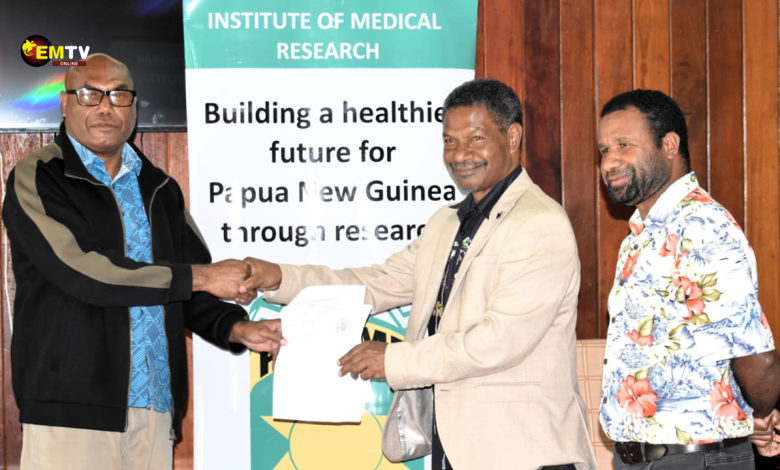
The grant agreement was formally signed on November 19 by PNGIMR Director Professor William Pomat and PNG Science and Technology Secretariat (PNGSTS) Director of Policy Henry Vuia, witnessed by research and scientific staff from both institutions.
Professor Pomat welcomed the funding initiative, saying limited financial support had prevented many important research ideas by Papua New Guinean scientists from progressing.
“It is encouraging that Papua New Guinea now has a government institution dedicated to supporting research through funding,” Professor Pomat said.
He described the initiative as an important opportunity for local scientists to access grants and undertake research addressing the country’s emerging challenges.
Dr Keven is among 22 recipients of the National Research and Development Grants coordinated by the PNGSTS, an initiative aimed at strengthening locally led scientific research.
Dr Keven said the immediate priority following the signing of the agreement would be to develop the research protocol and secure ethical clearance from the Institutional Review Board and the Medical Research Advisory Committee.
His research team will also engage key stakeholders, including Provincial Health Authorities across the Highlands region, establish memorandums of understanding and prepare implementation plans.
The study is expected to contribute scientific evidence towards understanding the relationship between changing climatic conditions and malaria transmission, potentially informing future public health planning and responses.
While the research has yet to establish whether local malaria transmission is occurring in highland communities, its findings could provide important insights into an emerging public health concern for Papua New Guinea.
The partnership between PNGIMR and PNGSTS reflects the Government’s commitment to strengthening national research capacity and supporting evidence-based responses to public health challenges.
ENDS////